Let the gateway own your API version prefix

Most HTTP APIs carry a version in the URL: /api/v1/orders, /v2/customers. It looks harmless, but that short string ends up in many places: in every client, in the OpenAPI spec, in every controller annotation and in the routing rules in front of the service. When version 2 arrives, all of them have to move together, and anything that is missed returns a 404.
This post shows how the Labs64.IO Ecosystem keeps that cost low: the API gateway owns the version prefix, and the service does not know it exists. It is written for backend developers and platform engineers who run several HTTP services behind a gateway on Kubernetes.
After reading, you will know:
- the common ways to version an HTTP API, and why the URL path is still the usual choice,
- why it matters which component owns the version prefix,
- how to move the prefix out of your code and into the gateway, with OpenAPI, Helm and the Kubernetes Gateway API,
- what still needs checking after the move.
Background: three ways to version an API
| Approach | Example | Good for | Cost |
|---|---|---|---|
| URL path | /api/v1/orders | Easy to see, cache, route and document | The version is part of every URL |
| Request header | Api-Version: 2026-01-01 | Clean URLs, fine-grained versions | Harder to test in a browser; proxies must know the header |
| Media type | Accept: application/vnd.acme.v2+json | Versioning per representation | Most complex to implement and explain |
URL path versioning remains the most common choice for public APIs, because a human can read it and every proxy can route on it. So the interesting question is not whether the version goes into the path, but who owns it.
In the Labs64.IO platform, every module (AuditFlow, the Payment Gateway, Checkout and others) runs behind one shared Traefik gateway. Each module gets its own public prefix, for example /auditflow/api/v1.
The problem: the version lives everywhere
When the service owns the prefix, the version is hard-coded in the application: in a @RequestMapping("/api/v1"), a servlet context path or a base-path setting. The gateway forwards the path unchanged. That has three costs:
- Every version change is a code change in the controller, the spec and the clients, released together.
- Running v1 and v2 side by side means two code paths inside the same service, or two deployments with different hard-coded paths.
- The module must know its public name. If the platform mounts AuditFlow under
/auditflow, that name leaks into the service’s configuration.
The root cause: a routing decision (which URL reaches which code) is made inside the application instead of in the routing layer.
The solution: route-level prefix, root-mapped service
The fix moves the prefix into three places that are about routing, and out of the code entirely. The change came with the Traefik-owned API versioning work in the Helm charts repository (pull request #2).
- The spec declares the prefix once, as a server URL.
- The Helm chart names the route and asks the gateway to strip the prefix.
- The gateway rewrites the path before the request reaches the service.
Step 1: the spec puts the prefix in servers
AuditFlow’s OpenAPI contract declares the prefix as a server URL and says who strips it:
servers:
  - url: /api/v1
    description: Via API Gateway (Traefik strips the module prefix)
paths:
  /audit/publish:
    post:
      operationId: publishEvent
No key under paths contains /api/v1. Code generators that read servers put the prefix into the client’s base URL, so generated clients still call the full public path.
Step 2: the chart declares the route
In the AuditFlow Helm chart, the route that carries the API names the prefix and asks for it to be stripped:
gateway:
  routes:
    # AuditFlow API (protected; strips '<prefix>/api/v1' — backend is root-mapped)
    - path: /api/v1
      port: 8080
      stripPath: true
The module prefix defaults to /<chart-name>, so the full public path becomes /auditflow/api/v1.
Step 3: the gateway rewrites the path
The shared library chart, chart-libs, turns that value into a Kubernetes Gateway API HTTPRoute. Rendered (other filters trimmed), the rule looks like this:
rules:
  - matches:
      - path:
          type: PathPrefix
          value: "/auditflow/api/v1"
    filters:
      # ... header, auth, rate-limit and compression filters ...
      - type: URLRewrite
        urlRewrite:
          path:
            type: ReplacePrefixMatch
            replacePrefixMatch: /
    backendRefs:
      - name: af-auditflow
        port: 8080
URLRewrite with ReplacePrefixMatch is part of the standard Gateway API, so this works with any conforming gateway. Labs64.IO uses Traefik, which also runs the shared auth, rate-limit and compression middlewares on the same route.
The outcome
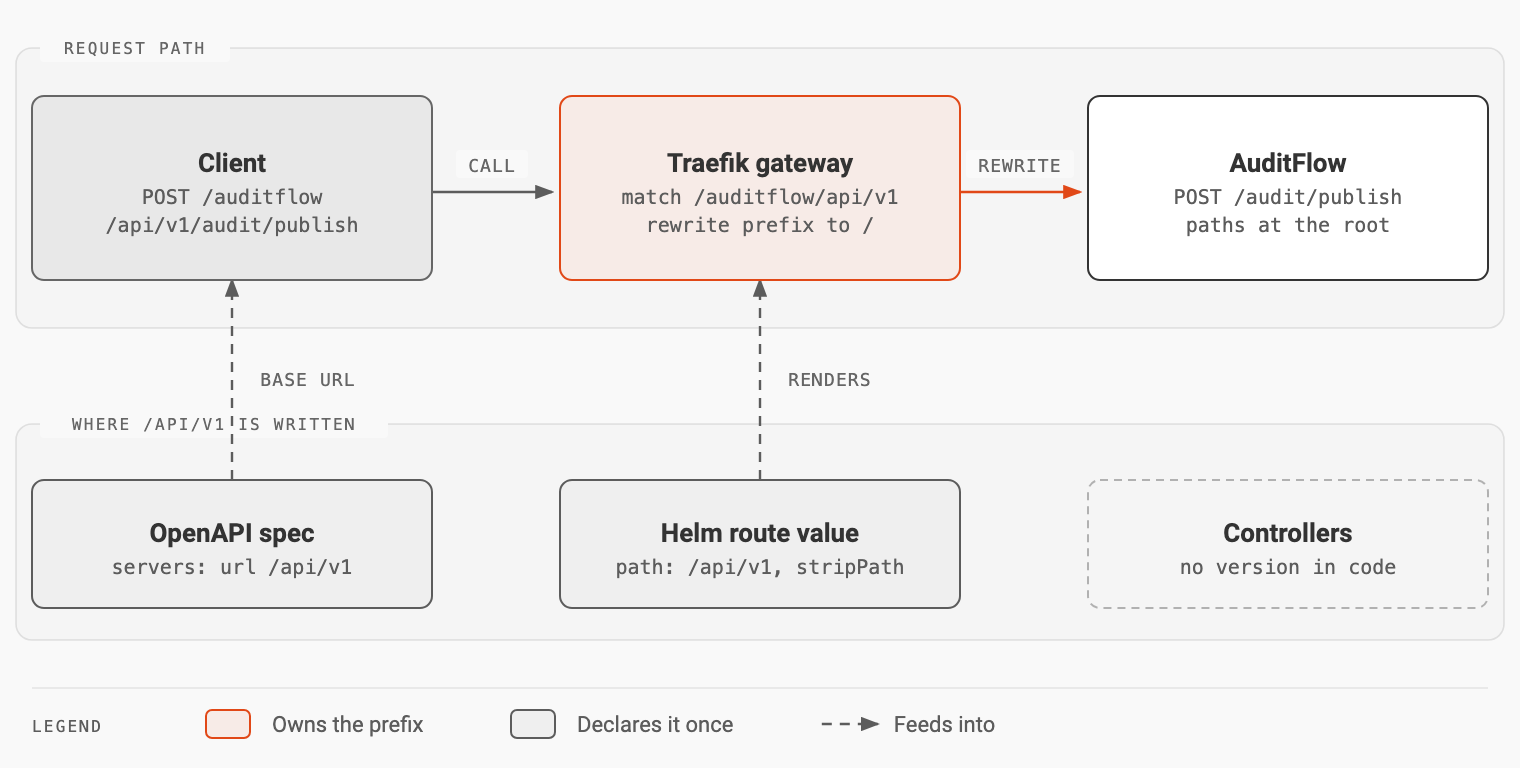
A client calls POST /auditflow/api/v1/audit/publish. The gateway matches the prefix, replaces it with /, and AuditFlow receives POST /audit/publish, exactly the path in its spec. The public OpenAPI document uses the same mechanism: /auditflow/v3/api-docs reaches the service as /v3/api-docs, without authentication.
| Service owns the prefix | Gateway owns the prefix | |
|---|---|---|
| Version string in controllers | yes | no |
Places that name /api/v1 | client, spec paths, controllers, route | spec servers, chart route |
| Adding v2 next to v1 | code change in the service | a second route |
| Service knows its public name | yes | no |
Trade-offs
- The prefix is still written twice: in the spec’s
serversentry and in the chart’s route. If they disagree, generated clients call a path the gateway does not route. A test that calls the service through the gateway, like those in the Labs64.IO regression suite, catches that. - Links the service builds itself need care. A service that returns absolute URLs (pagination,
Locationheaders) does not know its public prefix. Return relative links, or pass the public base URL in configuration. - Local runs without a gateway use root paths. Convenient for development; just remember it when you copy a URL from a log.
Apply it to your own service
- Move the version out of every key under
paths:and intoservers[].url. - Make your controllers serve the root paths.
- In your gateway route, match the public prefix and rewrite it to
/(URLRewrite,ReplacePrefixMatch: /). - Add one end-to-end test that calls the service through the gateway.
To see the rendered route yourself:
git clone https://github.com/Labs64/labs64.io-helm-charts.git && cd labs64.io-helm-charts
helm template af charts/auditflow --set gateway.enabled=true \
  --api-versions gateway.networking.k8s.io/v1 --api-versions traefik.io/v1alpha1
Key takeaways
- Versioning is a routing decision. Where a URL leads belongs in the routing layer, not in application code.
- Root-mapped services are version-neutral. The service serves
/audit/publish; the gateway decides that the world sees/auditflow/api/v1/audit/publish. - OpenAPI already has a place for the prefix:
servers[].url. Keeppathsfree of it, and generated clients still call the right URL. - The Gateway API can do the rewrite natively with
URLRewriteandReplacePrefixMatch, so the setup is portable across gateway implementations. - Two declarations need one test. The spec and the route must agree; an edge test makes sure they do.
The charts are in labs64.io-helm-charts, and the AuditFlow contract (openapi-audit-v1.yaml) is in labs64.io-auditflow. See also API-First / Contract-Driven and Modules, not a monolith.
Image Credits: Labs64.IO
Related Posts