Integrating Stripe Checkout safely: idempotency keys, signed webhooks and row locks
A hosted checkout looks simple: create a session, send the customer to the provider’s payment page, wait for confirmation. In a demo it works on the first try. In production, the network drops a request, a webhook arrives twice, and the customer’s browser comes back at the same moment as the provider’s confirmation. Each of those can turn into a double charge or a payment shown as failed although the money arrived.
This post shows how the Labs64.IO Payment Gateway integrates Stripe Checkout so that those situations are harmless (pull request #22). It is written for developers and integrators building any Stripe Checkout integration; the rules apply to other hosted checkouts as well.
After reading, you will know:
- the three things that break checkout integrations in production,
- how idempotency keys make session creation safe to retry,
- how to verify Stripe webhooks so that only Stripe can change a payment,
- how a row lock and final states make racing updates harmless.
Background: how Stripe Checkout works
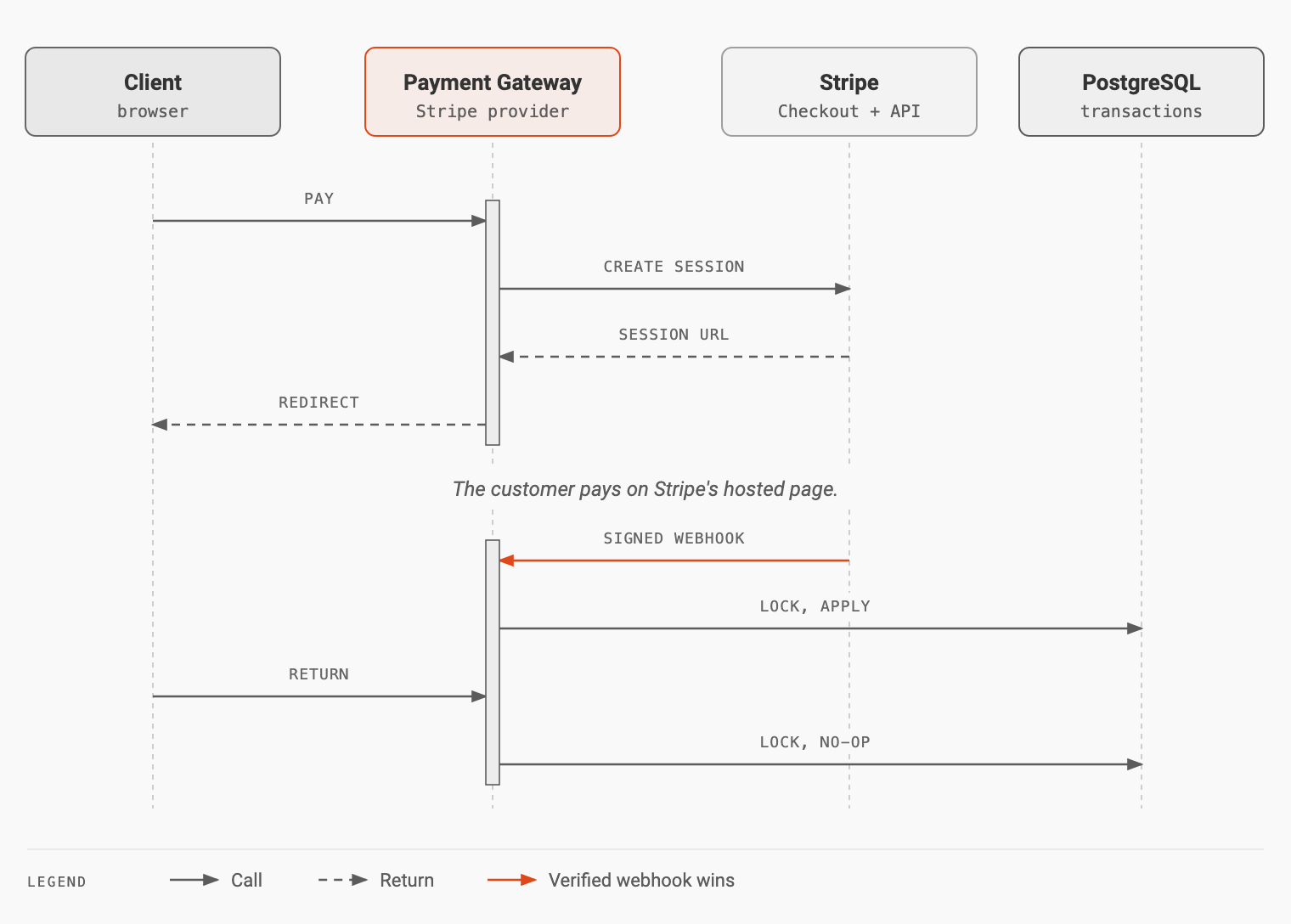
- Your server creates a Checkout session and gets a URL.
- The customer pays on Stripe’s hosted page.
- Stripe redirects the browser back to your site, and sends your server a webhook with the result.
Steps 3a and 3b are independent: either can arrive first, and Stripe delivers webhooks at least once, so the same event can arrive more than once.
The problem: retries, untrusted callbacks and races
- Retries. If your server retries a failed “create session” call and Stripe had in fact created the first one, the customer could end up with two sessions and pay twice.
- Untrusted callbacks. Your webhook endpoint is public. Anyone can send JSON to it; only a valid signature proves it came from Stripe.
- Races and duplicates. The browser return and the webhook may be processed at the same time, and a late or repeated event must not overwrite a final result.
The solution in four parts
Part 1: validate credentials when the provider is registered
A Stripe provider needs a secretKey and a webhookSecret. The gateway checks their shape (sk_ or rk_, and whsec_) when a tenant registers the provider, so a typo fails immediately rather than on the first payment:
{"code":"VALIDATION_ERROR","message":"Stripe secretKey must be a Stripe secret or restricted API key.", ...}
HTTP 400
It is a shape check only; it cannot tell whether a key is live.
Part 2: create sessions with an idempotency key
When the client calls /payments/{paymentId}/pay, the provider creates a Checkout session with an idempotency key equal to the gateway’s transaction ID. If the call is retried, Stripe returns the same session instead of creating a second one. The transaction ID is also stored in the session and payment-intent metadata, so webhooks can be matched later:
private static RequestOptions requestOptions(final UUID idempotencyKey) {
    return RequestOptions.builder()
            .setIdempotencyKey(idempotencyKey.toString())
            .build();
}
The return and cancel URLs that Stripe sees belong to the gateway; the client’s own URLs are validated and used only for the final redirect.
Part 3: accept only verified, known webhooks
event = Webhook.constructEvent(context.request().body(), signature, webhookSecret);
...
if (!context.transaction().id().equals(verifiedTransactionId)) {
    throw new WebhookRejectedException("Stripe webhook transaction does not match restored transaction.");
}
- The signature is checked against the exact raw request body, so nothing may rewrite the body before it.
- The transaction ID inside the verified payload must match the transaction the gateway loaded.
- Only four event types are accepted, with an explicit mapping; anything else is rejected with
400.
| Stripe event | Gateway result |
|---|---|
checkout.session.completed | SUCCESS if payment_status is paid or no_payment_required, otherwise PENDING |
checkout.session.async_payment_succeeded | SUCCESS |
checkout.session.async_payment_failed | FAILED |
checkout.session.expired | FAILED |
Part 4: apply every result under a lock, and keep final states final
Every provider result, from a webhook or from the browser return, goes through one method that loads the transaction with a pessimistic lock (SELECT ... FOR UPDATE) and does nothing if the transaction is already final:
@Lock(LockModeType.PESSIMISTIC_WRITE)
Optional<PaymentTransactionEntity> findByIdAndTenantIdForUpdate(UUID id, String tenantId);
Two results for one transaction run one after the other, and a late failure event cannot overwrite a successful payment.
The outcome
| Situation | Naive integration | With these rules |
|---|---|---|
| “Create session” retried | possible second session | same session returned |
| Forged webhook | may change a payment | rejected, 400 |
| Same event delivered twice | applied twice | second is a no-op |
| Webhook and browser return together | race, last writer wins | serialized; final state kept |
The repository’s Robot Framework suite (tests/e2e/stripe_psp_flow.robot) runs the gateway against a WireMock stand-in for Stripe and checks the request contract, replay, webhook signatures and terminal-state protection. A separate smoke test against Stripe test mode covers the hosted pages and real credentials.
Trade-offs
- Scope is one-time payments. The provider creates Checkout sessions in
paymentmode; refunds and Stripe Billing are not covered yet. - Locks serialize work per transaction. That is cheap for payments (few writers per transaction) and exactly what correctness needs.
Apply it to your own Stripe integration
- Use an idempotency key on every Stripe call that creates something.
- Store your own ID in the session and payment-intent
metadata. - Verify webhook signatures on the raw body; never parse and re-serialize first.
- Handle only the event types you know; reject the rest.
- Update payment state in one place, under a lock, and make final states final.
- For local testing, forward only the supported events with the Stripe CLI, and keep its temporary
whsec_secret apart from the Dashboard endpoint secret:
stripe listen \
  --events checkout.session.completed,checkout.session.async_payment_succeeded,checkout.session.async_payment_failed,checkout.session.expired \
  --forward-to http://localhost:8080/providers/stripe/webhooks
The full setup is in the Stripe guide.
Key takeaways
- Production breaks checkouts in three ways: retries, untrusted callbacks, and racing or duplicate updates.
- Idempotency keys make creation safe to retry; your own transaction ID is a natural key.
- Only a verified signature can change a payment, checked on the raw body and matched to the expected transaction.
- One locked update path, final states final: the second writer finds the result and does nothing.
- Test the contract offline, the integration online: a stand-in for the API logic, a smoke test for the real provider.
The code is in labs64.io-payment-gateway under payment-gateway-providers/stripe; it plugs into the SPI described in One payment API, many PSPs.
Image Credits: Labs64.IO
Related Posts