Payment idempotency keys in Redis: two Lua scripts
A client retry, a network blip or a load balancer timeout must never charge a customer twice. The client cannot know whether its first “pay” request reached the server before the connection dropped, so it sends it again. Whether that second request becomes a second charge is entirely up to the server.
This post explains the standard defence, the idempotency key, and how the Labs64.IO Payment Gateway implements it with Redis and two small Lua scripts after first doing it in PostgreSQL (pull request #31). It is written for backend developers and architects who design APIs where a repeated request must not repeat a side effect.
After reading, you will know:
- what an idempotency key must guarantee, including the case that is easy to forget,
- why Redis fits this better than a database table,
- how two atomic scripts implement the whole state machine without locks,
- how an owner token makes timeout takeover safe.
Background: the idempotency key
The pattern became popular through payment APIs such as Stripe’s, and an IETF draft describes the Idempotency-Key HTTP header. The client sends a unique key with a request; the server promises that one key produces one result. An implementation must handle five situations:
- First request: process it and remember the result.
- Repeat after completion: return the stored result without processing again.
- Repeat while the first is still running: do not process in parallel.
- Same key, different request body: refuse, because the client made a mistake.
- The first request died halfway: let a later retry take over, without letting the dead request write a result if it comes back.
The problem: the PostgreSQL version was heavy
The first design used a JPA entity with a unique index on tenant, operation and key. A request hashed its body and inserted a PROCESSING row with ON CONFLICT DO NOTHING; the winner owned the key, the loser replayed the stored response. A scheduled job deleted expired rows.
It worked. But it needed an entity, a repository with pessimistic locking, a cleanup scheduler and five settings (redisTtl, databaseTtl, processingTimeout, cleanupInterval, cleanupBatchSize), for a record that is written once, read rarely and thrown away after a few hours.
The solution in three parts
Part 1: one Redis hash per key, with a TTL
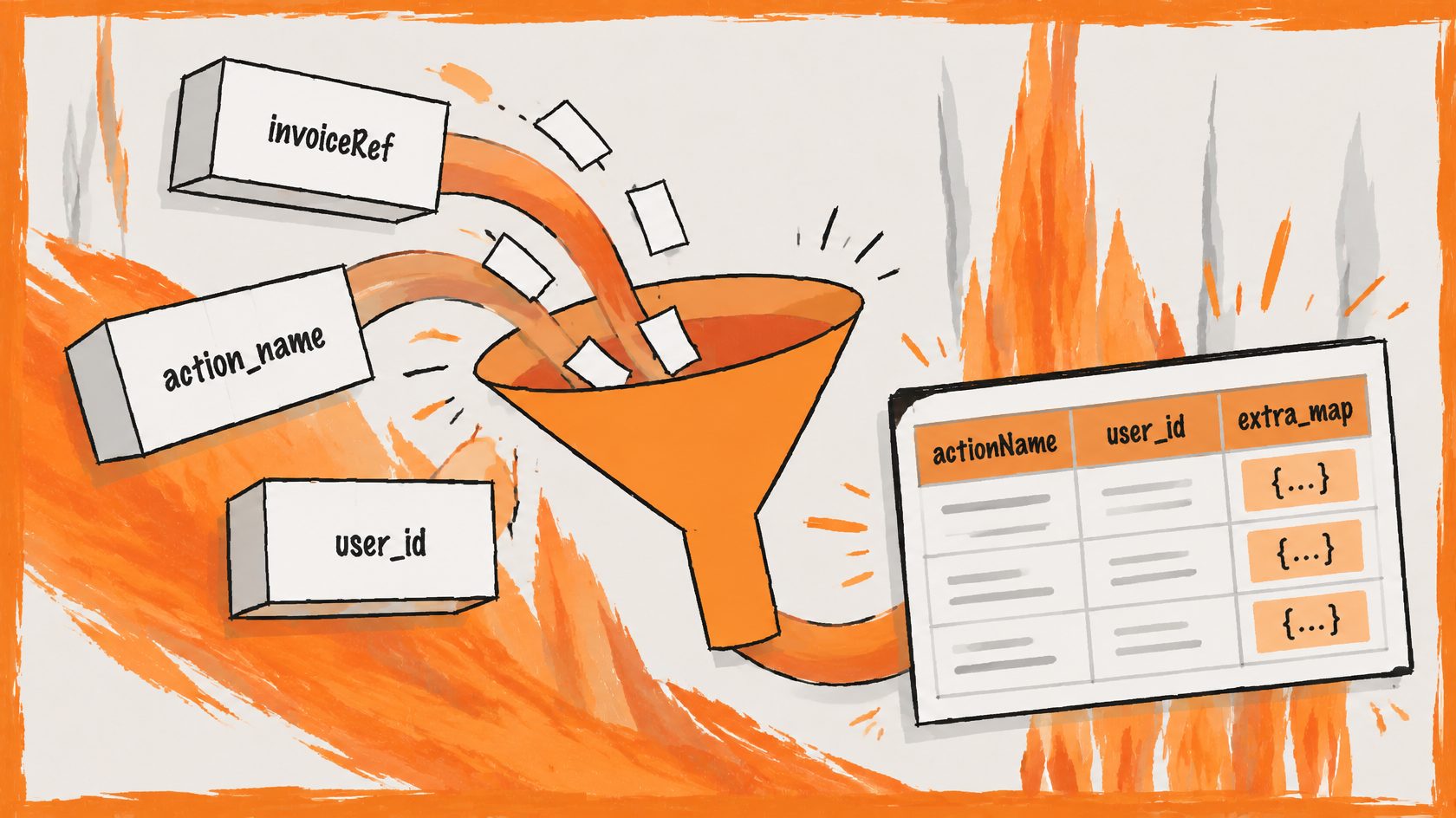
Redis offers exactly what the record needs: expiry built in (no cleanup job), atomic server-side scripts (no distributed lock) and a simple hash. The Redis key is payment-gateway:idempotency: plus a SHA-256 of tenant, operation and client key, so no client-supplied text ends up in a key name. The hash holds:
requestHash       SHA-256 of the canonical request
status            PROCESSING | COMPLETED
executionToken    proves which attempt owns the key
startedAt         epoch milliseconds, for timeout detection
responseStatus    (when completed)
responseHeaders   JSON (when completed)
responseBody      JSON (when completed)
Part 2: the state machine in two scripts
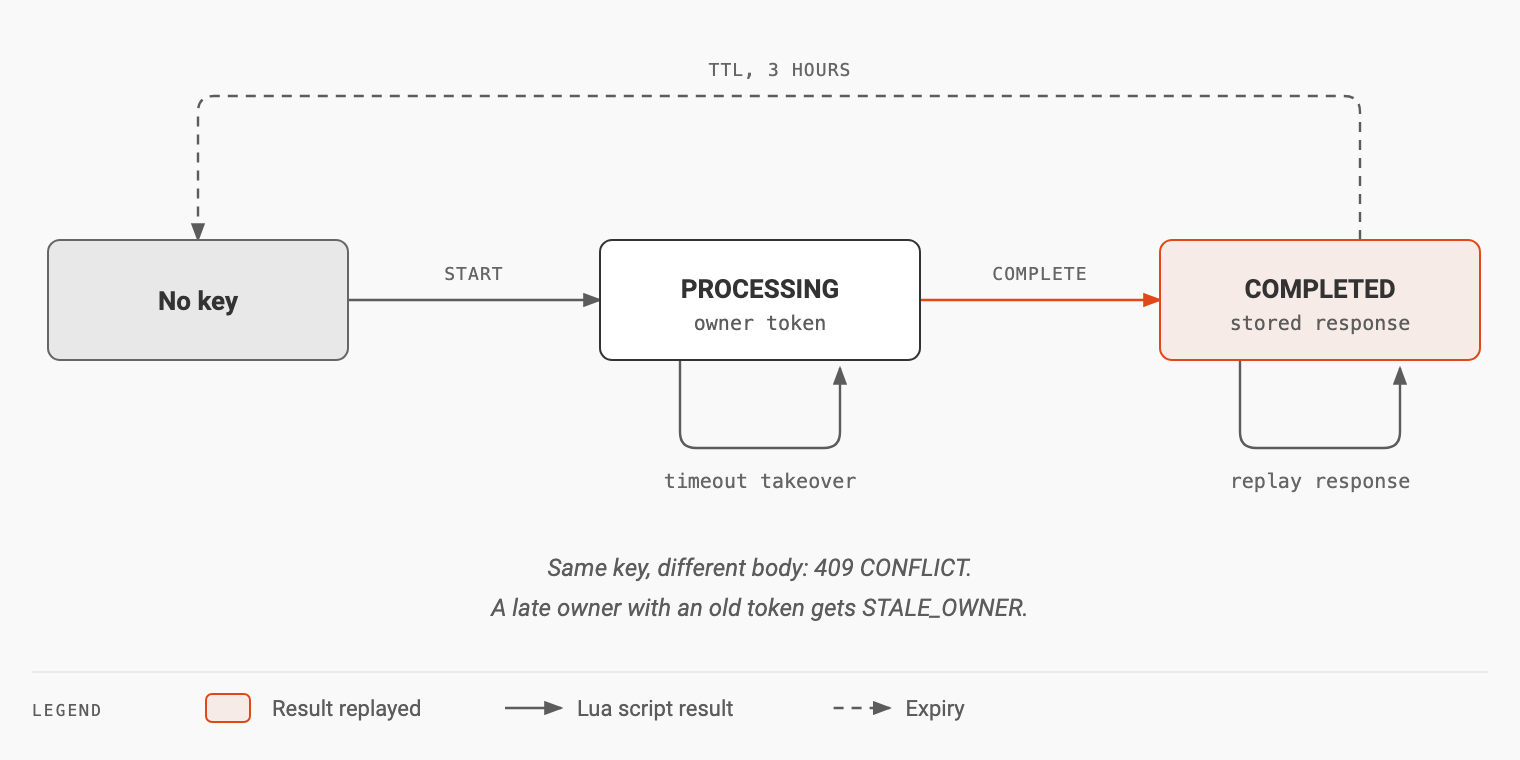
start-or-replay.lua runs when a request arrives and returns one of four answers: STARTED (new key, or previous owner timed out), COMPLETED (with the stored response to replay), PROCESSING (another request is still working) or CONFLICT (same key, different body). Its core:
local requestHash = redis.call('HGET', KEYS[1], 'requestHash')

if not requestHash then
    redis.call('HSET', KEYS[1],
        'requestHash', ARGV[1],
        'status', 'PROCESSING',
        'executionToken', ARGV[2],
        'startedAt', now)
    redis.call('PEXPIRE', KEYS[1], ARGV[3])
    return {'STARTED'}
end

if requestHash ~= ARGV[1] then
    return {'CONFLICT'}
end
complete.lua runs when processing ends and stores the response only if the caller still owns the key.
Part 3: an owner token makes takeover safe
local executionToken = redis.call('HGET', KEYS[1], 'executionToken')
if executionToken ~= ARGV[2] then
    return 'STALE_OWNER'
end
Without the token, a slow first request and a retry that took over after the timeout could both finish and both write a result. With it, only the current owner can complete; the other gets STALE_OWNER.
Two timers do different jobs: the TTL (IDEMPOTENCY_REDIS_TTL, default 3 hours) is how long a result is remembered; the processing timeout (IDEMPOTENCY_PROCESSING_TIMEOUT, default 5 minutes) is how long to wait before assuming the original caller died.
The outcome
Through the real API (the Payment Gateway quick start uses the NoOp provider, so no PSP account is needed), paying the same payment twice with one key:
for i in 1 2; do
  api -X POST localhost:8080/payments/$PAYMENT/pay -H "Idempotency-Key: order-1001" \
    | grep -o '"status":"[A-Z]*"' | tr '\n' ' '; echo
done
api "localhost:8080/payment-transactions?paymentId=$PAYMENT" | grep -o '"totalItems":[0-9]*'
"status":"CLOSED" "status":"SUCCESS"
"status":"CLOSED" "status":"SUCCESS"
"totalItems":1
Two calls, one transaction. Reusing the key with a different body returns 409 with IDEMPOTENCY_CONFLICT.
| PostgreSQL version | Redis version | |
|---|---|---|
| Moving parts | entity, locking repository, cleanup job | one hash, two scripts |
| Expiry | scheduled cleanup | Redis TTL |
| Concurrency control | row locks | atomic scripts |
| Settings | five | two |
You can also run the scripts alone against a throwaway Valkey (a Redis-compatible server); they live in payment-gateway-be/src/main/resources/redis/idempotency/:
docker run -d --rm --name idem-demo valkey/valkey:8-alpine
docker cp start-or-replay.lua idem-demo:/s.lua
docker cp complete.lua idem-demo:/c.lua
R() { docker exec idem-demo valkey-cli "$@"; }

R --eval /s.lua demo:key , hashA token1 10800000 300000   # STARTED
R --eval /s.lua demo:key , hashA token2 10800000 300000   # PROCESSING
R --eval /s.lua demo:key , hashB token2 10800000 300000   # CONFLICT
R --eval /c.lua demo:key , hashA token1 201 '{}' '{"id":"p1"}' 10800000   # COMPLETED
R --eval /s.lua demo:key , hashA token3 10800000 300000   # COMPLETED, 201, {}, {"id":"p1"}
docker rm -f idem-demo
Trade-offs
- Redis is now on the write path. If the script call fails, the request fails, on purpose: no payment runs without protection.
- The window is the TTL. A retry after three hours with the same key is treated as a new request.
- Keys are hashes. To find one by hand, compute the same SHA-256 (tenant, operation and key, each followed by a zero byte).
Apply it to your own API
- Accept an
Idempotency-Keyheader on every operation with side effects. - Store, per key, a hash of the request, a status, an owner token and the response.
- Implement claim-or-replay and complete-if-owner as atomic operations (Lua in Redis, or a transaction in a database).
- Choose the TTL from your clients’ retry window, and the processing timeout from your slowest operation.
Key takeaways
- The server decides whether a retry becomes a duplicate. Idempotency keys make that decision explicit.
- Five situations, not one: first request, repeat, concurrent repeat, misuse, and a dead first attempt.
- Short-lived records fit a cache with expiry. A TTL replaces cleanup jobs; atomic scripts replace locks.
- An owner token makes takeover safe, so a request that comes back to life cannot overwrite the real result.
- Fail closed: without the idempotency store, no payment should run.
The Java side is RedisIdempotencyRepository in labs64.io-payment-gateway. The same two-script pattern fits webhook deduplication and any other “exactly once within a window” problem.
Image Credits: Labs64.IO
Related Posts