Self-describing API responses: a JSON Schema URI in every object
Most API integrations start the same way. A developer reads a documentation page, guesses the shape of an object, and writes a parser. If the guess is wrong, the first real payment fails, or worse, a field quietly parses to null. And when the API changes a year later, nobody knows which version of the object the client was written against.
This post shows how the Labs64.IO Payment Gateway puts the contract into the payload itself: every public response object names the versioned JSON Schema that describes it. It is written for API designers and integrators who want contracts that clients, tests and tools can check automatically.
After reading, you will know:
- what a self-describing response is and why it helps integrators,
- how to generate versioned JSON Schema files from an OpenAPI document,
- how to publish them at stable addresses and reference them from the payload,
- what a schema does and does not promise.
Background: what “self-describing” means
A self-describing message carries a pointer to its own description. JSON Schema reserves the $schema keyword for that idea inside schema documents, and many data formats use a $schema property the same way (VS Code settings files are a familiar example): a tool sees the URI, fetches the schema, and knows how to validate, autocomplete or generate code.
The problem: the contract lives somewhere else
An OpenAPI document describes the whole API, but a client holding one JSON object cannot tell from the object itself:
- which contract it follows,
- which version of that contract,
- where to find a machine-readable description to validate it against.
Hand-written JSON Schema files would answer that, but they drift from the API the first time someone edits the OpenAPI file.
The solution in three parts
Part 1: every public object names its schema
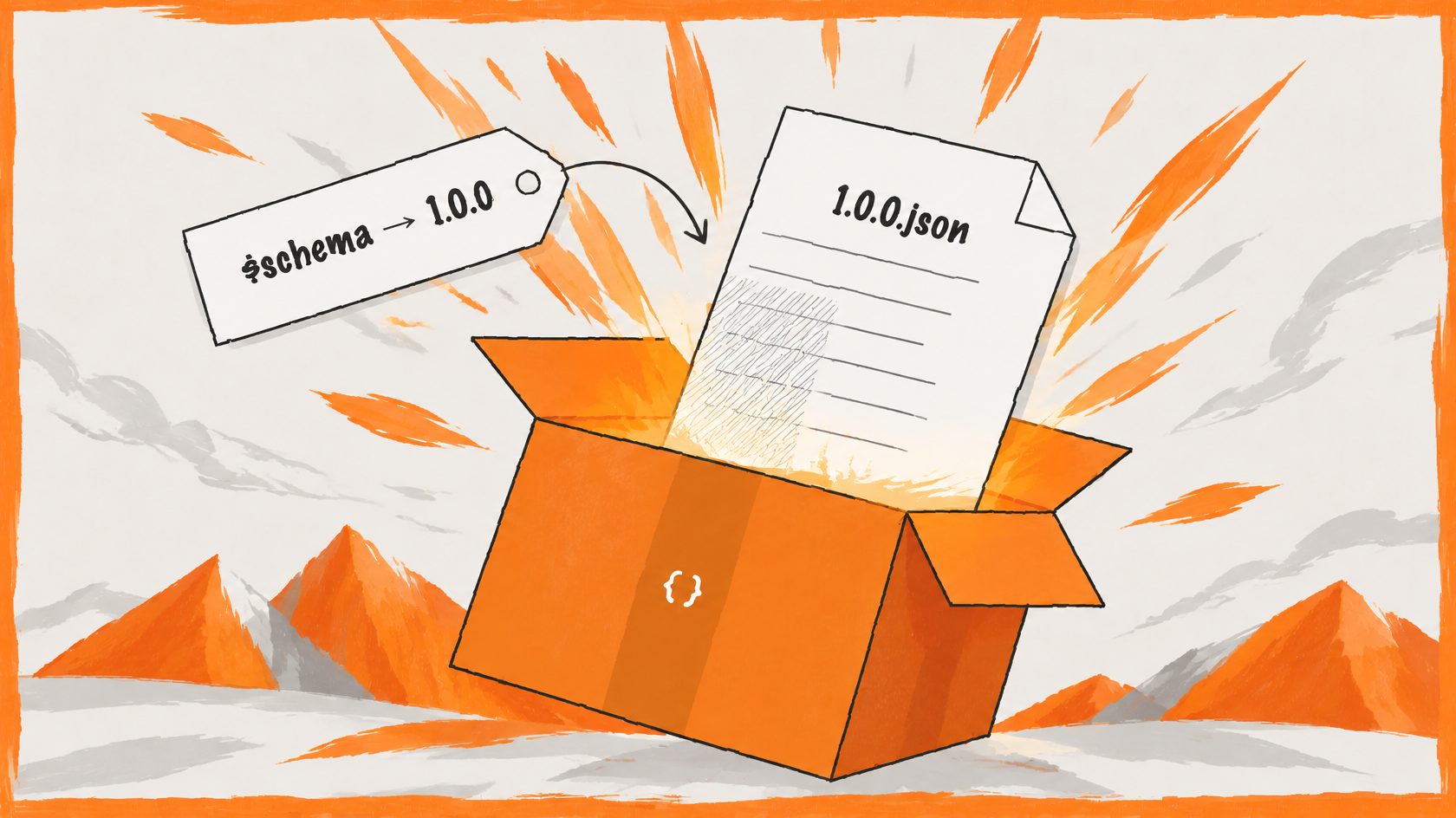
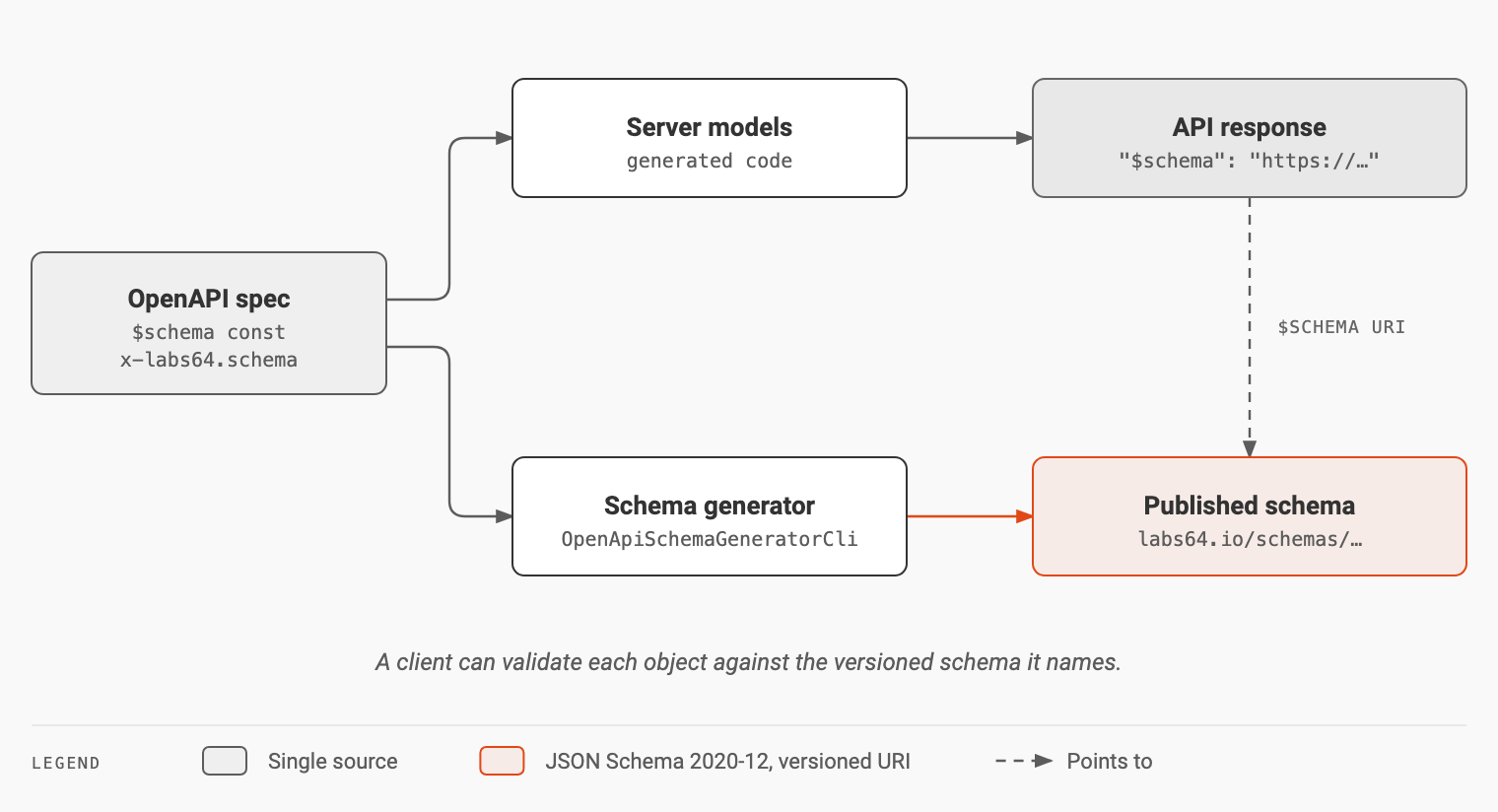
In the OpenAPI source (openapi-payment-gateway-v1.yaml), each public component, such as Payment, PaymentProvider, PaymentTransaction and the checkout confirmations, has a required, read-only $schema property with a fixed value, plus an x-labs64 extension recording the object and version:
PaymentProvider:
  type: object
  additionalProperties: false
  properties:
    $schema:
      type: string
      format: uri
      readOnly: true
      const: "https://labs64.io/schemas/payment-gateway/PaymentProvider/1.0.0.json"
  x-labs64:
    schema:
      object: PaymentProvider
      version: "1.0.0"
The const makes the URI part of the contract. The field is really emitted; listing providers on a local gateway (see the quick start) returns objects that begin like this:
{"$schema":"https://labs64.io/schemas/payment-gateway/PaymentProvider/1.0.0.json","id":"2416f718-...","provider":"noop","name":"No-Op (Test)", ...}
Part 2: schemas are generated from the same OpenAPI file
A small generator, OpenApiSchemaGeneratorCli, extracts each component into its own JSON Schema document. It runs through two just recipes, with a dry run that writes nothing:
just schemas-generate <output-dir>   # write the schema files
just schemas-dry-run  <output-dir>   # show what would change, write nothing
CREATE    schemas/payment-gateway/PaymentProvider/1.0.0.json  [component=PaymentProvider, revision=1.0.0]
CREATE    schemas/payment-gateway/Payment/1.0.0.json  [component=Payment, revision=1.0.0]
...
Dry run: no files written.
Part 3: published at stable, versioned addresses
The files are published on this website under schemas/payment-gateway/<Object>/<version>.json. Each is a JSON Schema draft 2020-12 document with its own $id; references to other objects use absolute URIs instead of local fragments:
"payment": {
  "$ref": "https://labs64.io/schemas/payment-gateway/ConfirmationPayment/1.0.0.json"
}
The version is part of the URI, so a client built against 1.0.0 keeps resolving exactly that contract after a later version ships. additionalProperties: false and required lists make the schemas strict.
The outcome
A client can now take any object, read $schema, fetch the schema and validate:
curl -s https://labs64.io/schemas/payment-gateway/PaymentProvider/1.0.0.json -o provider.json
python3 -m venv .venv && . .venv/bin/activate && pip install jsonschema
python - <<'PY'
import json, jsonschema
schema = json.load(open("provider.json"))
payload = {"$schema": schema["$id"], "id": "550e8400-e29b-41d4-a716-446655440010",
           "provider": "stripe", "name": "Stripe", "description": "Cards", "recurring": True}
jsonschema.validate(payload, schema)                       # passes
jsonschema.validate({**payload, "provider": 42}, schema)   # raises ValidationError
PY
The second call fails with 42 is not of type 'string'.
| Docs-only contract | Self-describing responses | |
|---|---|---|
| Which contract does this object follow? | guess from the docs | $schema says so |
| Machine-readable description | the whole OpenAPI file | one schema per object and version |
| Drift between docs and API | possible | generated from the same source |
| Old clients after a new version | unclear | old URI still resolves |
Trade-offs
- A schema describes shape, not meaning. Whether a payment succeeded is a question for the
statusfield and the documentation, not for the schema. - Strict schemas need careful nullability. OpenAPI 3.0’s
nullablekeyword has no meaning in JSON Schema 2020-12; fields that can benullmust be declared with anulltype, or a validator will reject real responses.
Apply it to your own API
- Add a read-only
$schemaproperty with aconstURI to each public object in your OpenAPI document. - Generate one JSON Schema file per object and version from that document; never write them by hand.
- Publish them at versioned URIs, with absolute
$refs between them. - Never change a published version; a breaking change gets a new URI.
- Validate real responses against the published schemas in CI.
Key takeaways
- A self-describing object tells every client which contract it follows and where to fetch it.
- Generate schemas from the API contract, so documentation and implementation cannot drift.
- Put the version in the URI and keep published versions immutable; old clients keep working.
- Strictness is a feature with a cost:
additionalProperties: falsecatches typos, but nullability must be modelled correctly. - Schemas describe shape, not behaviour; documentation still explains what values mean.
To regenerate the schemas yourself, clone labs64.io-payment-gateway, create an empty directory and run just schemas-dry-run with it. The Payment Gateway docs cover the API itself.
Image Credits: Labs64.IO
Related Posts