FastAPI health checks failing? Try def instead of async def
During load testing, Kubernetes started restarting every replica of a Python service, one after another. The service was not crashing and not out of memory; its health endpoint simply stopped answering in time. The cause was a single keyword, and the fix was to delete it.
This post explains what happened in the Labs64.IO Auth Gateway, the FastAPI service that checks every request to the platform, and how to avoid it in your own services. It is written for Python developers and operators who run FastAPI (or any ASGI framework) on Kubernetes.
After reading, you will know:
- how FastAPI runs
async defanddefhandlers differently, - why one blocking call can make a healthy pod fail its liveness probe,
- a one-minute experiment that shows the effect,
- how to write a test that keeps the fix from regressing.
Background: async def and def in FastAPI
FastAPI supports both kinds of handler, and treats them very differently:
- An
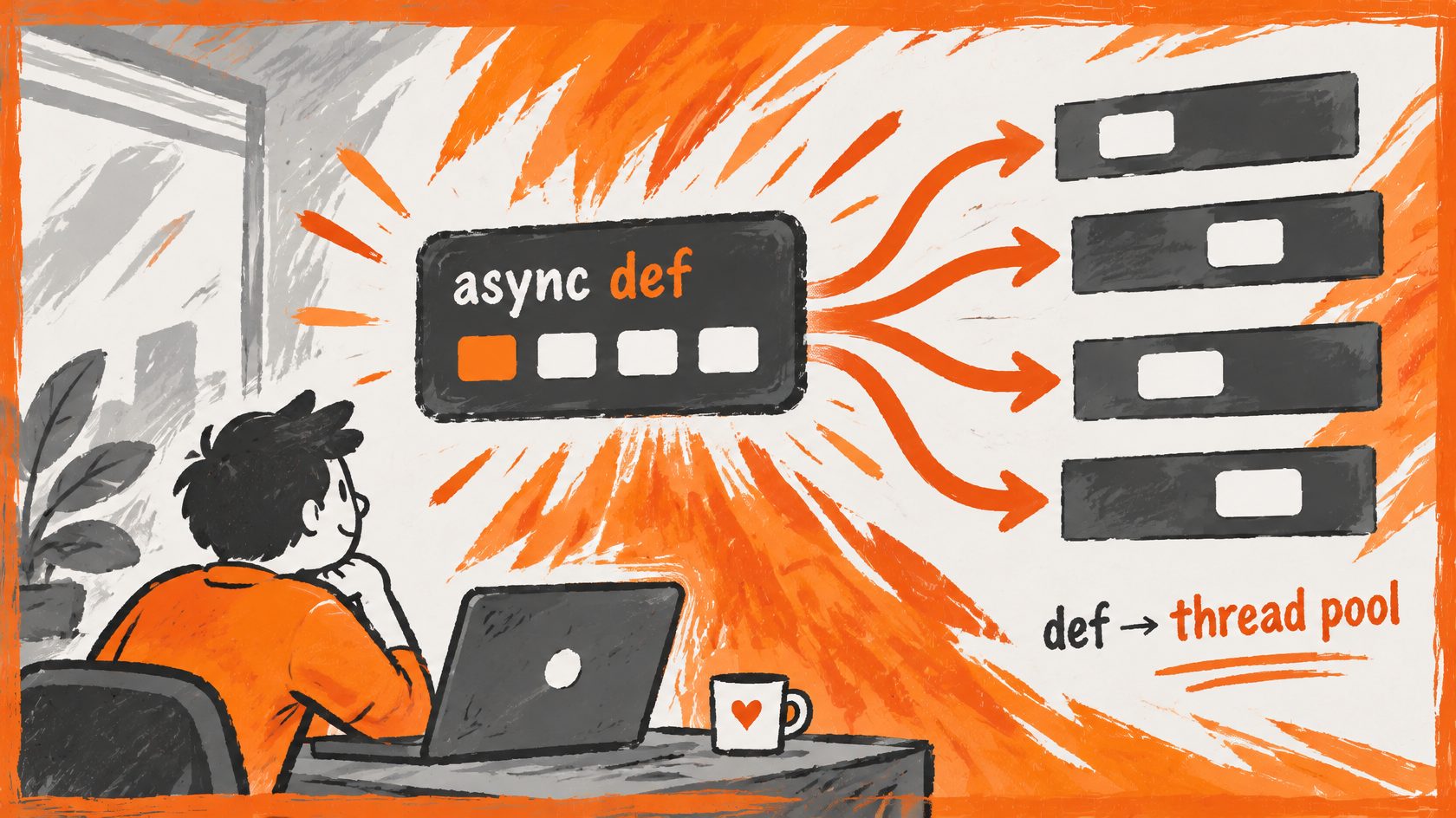
async defhandler runs directly on the event loop. All requests on that worker share the loop; it can serve many of them only while each one is awaiting something. - A plain
defhandler runs in a thread pool. The loop hands it to a worker thread and stays free for other requests.
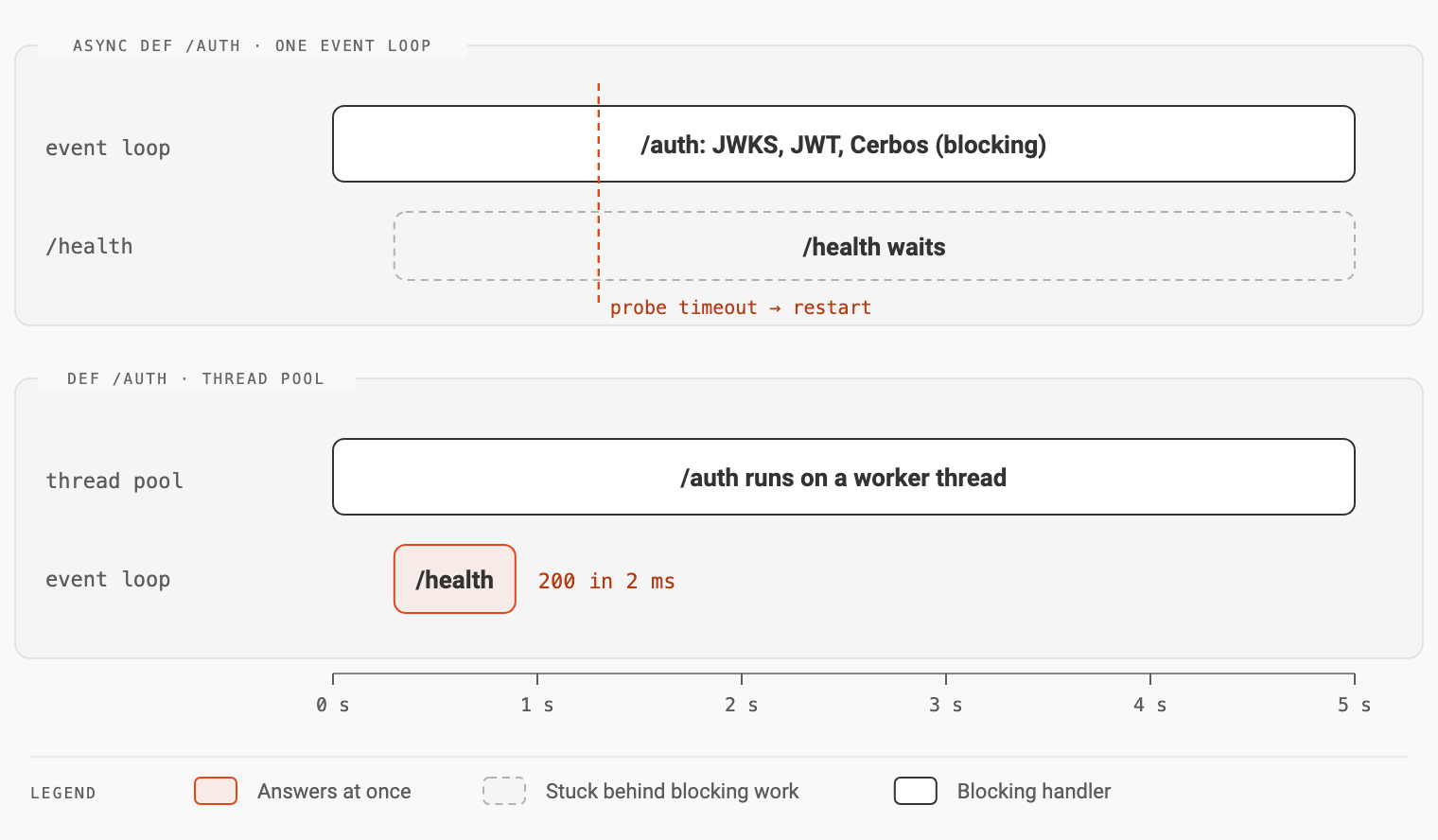
So async def is fast only if everything inside it is non-blocking. A blocking call (a synchronous HTTP client, a synchronous SDK, time.sleep) freezes the whole loop until it returns.
The problem: blocking work inside async def
For each request, the Auth Gateway verifies a JWT, may refresh signing keys from the identity provider, and asks the Cerbos policy service whether the caller is allowed. All of that is blocking work, and the /auth handler was declared async def.
Under load, a few slow /auth calls held the event loop. Every other request on the pod waited, including /health. The kubelet’s liveness probe missed its deadline a few times, Kubernetes restarted the pod, the remaining pods got more traffic, and the problem spread.
The solution in two parts
Part 1: declare blocking handlers with def
The /auth handler is now a plain function, and its docstring records why:
@app.get("/auth", response_model=AuthResponse, tags=["Auth"])
@app.post("/auth", response_model=AuthResponse, tags=["Auth"])
def authenticate(request: Request):
    """Authenticate and authorize a request forwarded by Traefik.

    A plain (sync) handler on purpose: FastAPI runs it in the thread pool. JWT verification, the JWKS
    fetch and the Cerbos call all block; inside an ``async def`` they stalled the event loop, so under
    load /health missed its probe deadline and the kubelet restarted every replica.
    """
/health stays async def, because it does no blocking work.
Part 2: a test that proves the loop stays free
A regression test reproduces the failure: three /auth requests are made to block on a slow decision, and while they do, /health must answer in under a second:
def test_health_answers_while_auth_requests_block(store, monkeypatch):
    ...
    with TestClient(app) as shared:
        blocked = [threading.Thread(target=shared.get, args=("/auth",), ...) for _ in range(3)]
        for t in blocked:
            t.start()
        time.sleep(0.3)
        started = time.monotonic()
        assert shared.get("/health").status_code == 200
        assert time.monotonic() - started < 1.0
One TestClient context means one shared event loop, as under uvicorn. The test fails with async def and passes with def.
Running handlers on threads means shared state needs care, so two more changes went in: one pooled, thread-safe Cerbos client instead of a new connection per request, and an atomic replacement of the signing-key cache, so no request ever sees a half-refreshed key set.
The outcome
You can see the effect in a minute. Save this as app.py:
import time
from fastapi import FastAPI

app = FastAPI()


@app.get("/work")
async def work():          # change this line to: def work():
    time.sleep(5)
    return "done"


@app.get("/health")
async def health():
    return "ok"
pip install fastapi uvicorn
uvicorn app:app --port 8000 &
curl -s http://localhost:8000/work --max-time 1 > /dev/null &
curl -s -w "%{http_code} in %{time_total}s\n" http://localhost:8000/health --max-time 3
Handler for /work | /health while /work runs |
|---|---|
async def | no answer within 3 seconds (curl times out) |
def | 200 in 0.0019s |
In the Auth Gateway, the same change ended the restart loop under load.
Trade-offs
- The thread pool is finite. FastAPI’s sync handlers run in AnyIO’s worker pool (40 threads by default). Slow downstream calls still need timeouts, or the pool fills up.
- Threads need thread-safe state. Shared clients and caches must be safe for concurrent use, as the two follow-up changes show.
Apply it to your own FastAPI services
- List every
async defhandler and check what it calls. Anything synchronous that touches the network or disk is blocking. - Declare those handlers with
def, or wrap the blocking calls inrun_in_threadpool. - Keep
async deffor handlers that only await non-blocking libraries. - Add a test that blocks some requests and checks that
/healthstill answers quickly. - Make shared clients and caches thread-safe.
Key takeaways
async defruns on the event loop;defruns on a thread. The keyword decides how FastAPI schedules your code.- One blocking call in an
async defhandler freezes every request on that worker, health checks included. - Failed liveness probes can be a concurrency bug, not a resource problem.
- If a handler blocks, use
def. Reserveasync deffor code that only awaits. - Test behaviour under contention, not only the happy path, so the fix cannot regress unnoticed.
The code is in labs64.io-authproxy (tests/test_auth_decision.py holds the regression test); the Zero-Trust Edge Proxy page shows where the gateway fits. AuditFlow hit the same issue in its sink service, described in Bounded waits beat fail-fast.
Image Credits: Labs64.IO
Related Posts